 FR
Volterra 3 resistivity instrument
Traditional Vertical Electrical Sounding (VES) equipment used for siting is expensive (€10.000 – 30.000) and is sparsely available in low-income countries. The equipment has hardly changed in the last 50 years, with paper record keeping and computer analyses still part of today’s VES measurements. Together with the high level of required skills, these are barriers for a larger group of users who could really benefit from VES during siting.
Over the past five years, PRACTICA has developed a simplified device to match the current single point siting equipment. The result is the smartphone operated Volterra 3 instrument, which is a fraction of the cost of traditional VES equipment and yet gives identical results. The device has been validated through lithology and depth proofing in Mauritania, Mali, Chad, Mozambique, Madagascar and Liberia.
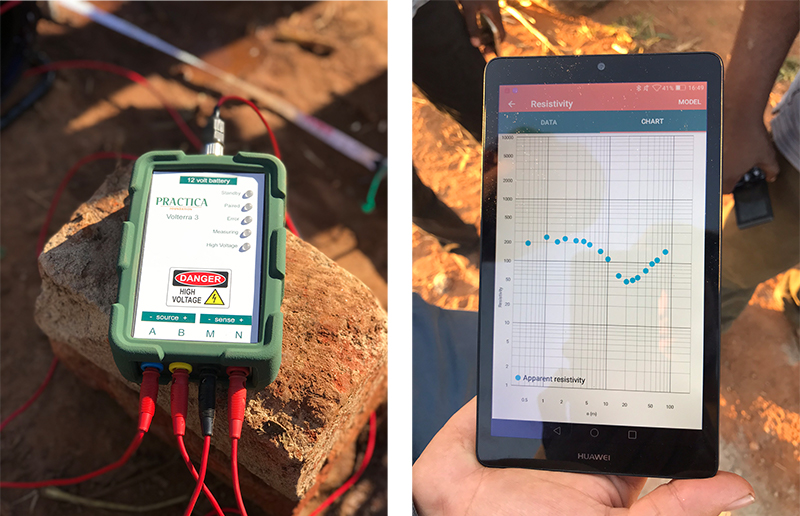
Left: The Volterra 3 device. The dimensions are 17 x 12 x 7 cm. Right: captured data.
The Volterra 3 measures ground resistance and can be used to perform Vertical Electrical Soundings (VES) or Horizontal Electrical Profiling (HEP). The 10-watt device is controlled through a smartphone app (Android only) via Bluetooth. Functionality includes fully automated measurement including background removal, stacking, and filtering. Power level and waveform duration can be set automatically or manually. Captured data is immediately shown in a graph on the smartphone, which minimises operator measurement errors. Before every measurement, short pulses of electricity are emitted that act as a safety warning.
Data capture
The Volterra instrument and control app can be used on their own, in which case a single resistance is measured, with the user needing to apply the geometric factor. The recommended use is to combine it with the Driller’s Toolbox app, also developed by PRACTICA. In the Driller’s Toolbox app, a complete VES or HEP measurement can be defined, including array type (Wenner or Schlumberger), and array spacings. The captured data is exported to a pdf report and excel file, including modelling results, which the user receives by email. In this way, data can be interpreted remotely by geo-hydrologists, which enables cheap and rapid assessments.
The portable size makes it easy to carry to the field or on a plane, especially as it uses an external 12V car or motorcycle battery. Due to its small size, simple user interface, and low cost, it brings geophysics into the reach of a much broader audience such as drillers and NGOs, both in the development and humanitarian sector.
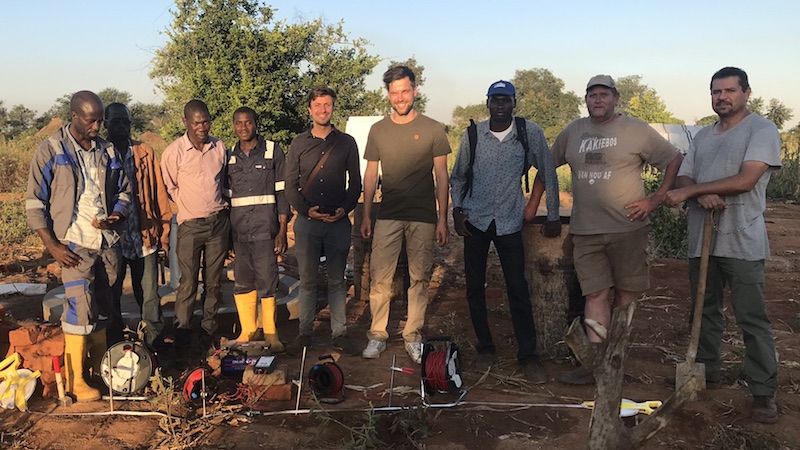
Using the Volterra device for resistivity measurements in Mozambique (photo: Dorcas).
Interested?
If you are interested in the Volterra 3 instrument, please contact us to find out more. You can also read this brochure.