 FR
Groundwater development
The role of groundwater to meet drinking water and irrigation needs will significantly increase in the coming decades, with sustainable management as key focus to reach the SDG goals. Thousands of implementation programs run by NGOs and Governments contribute to these goals by constructing water points by drilling boreholes. Due to the large numbers of foreseen new boreholes, and the potential of harmful environmental impact due to increased extraction of groundwater, it is essential that groundwater development is performed in a sustainable way.
In this area, PRACTICA works on three subjects: supporting manual drilling, siting boreholes, and improving data management. We continuously strive to use and integrate best practices and approaches from different countries, and we use our R&D capacity in the Netherlands and Madagascar to innovate in this theme.
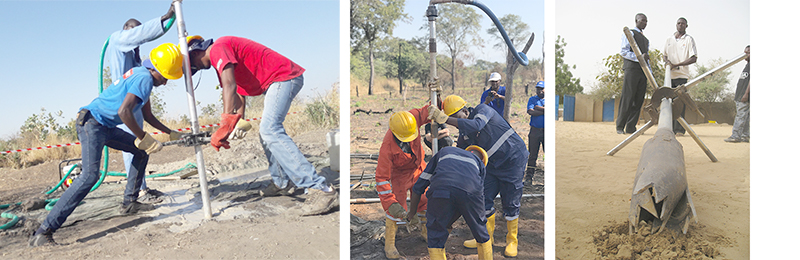
Manual drilling with the Rotary Jetting Kit developed by PRACTICA.
Manual drilling
Manual well drilling techniques are a good complementary approach to conventional machine drilling methods or hand dug methods to utilize groundwater. The costs are often 2 to 5 times cheaper than conventional drilling for wells of equal quality, and the equipment can be produced locally – which allows small enterprises to start up a business. In addition, as manual drilling equipment is lightweight, remote areas can be accessed to serve communities that are not reached by national water supply programs.
PRACTICA works on professionalizing the manual drilling sector throughout Africa by large capacity building programs. In collaboration with UNICEF, a manual drilling toolkit was produced in French and English with geo-hydrological feasibility mappings of 14 countries in Africa, together with practical training, construction and education manuals, as well as video’s and advocacy materials.
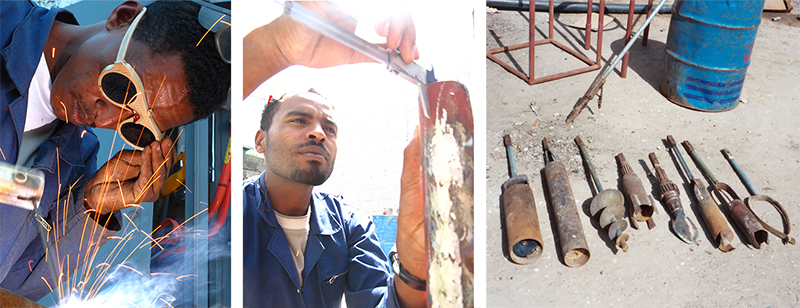
We help local enterprises construct drilling equipment.
Within the past 20 years, PRACTICA has had a significant impact in the dissemination of low-cost drilling techniques in over 15 countries, and has trained & equipped over 150 small companies to offer their services to the sector. With a sectoral approach, we guide NGO’s and governments on the introduction of manual drilling offering tailor made training to both development and relief sector.
For emergencies, there is often insufficient time and a lack of good materials to produce tools locally. For this reason, we have developed a high-end manual rotary jetting kit to provide immediate response. The kit can be flown in to be used by WASH experts in drilling boreholes. The equipment is made in such a way that it can be replaced and repaired with local components, making it an ideal technology to be transferred to the private sector in transition to development.
Siting with geophysics
Geophysical siting is an integral part in water point construction. It provides information on the choice of the drilling method, the likely cost, the expected drilling depth and the lithology a driller may encounter. Siting can significantly increase the efficiency of water programs, especially when it is used to plan a batch of boreholes and a selection on the most promising areas is required.
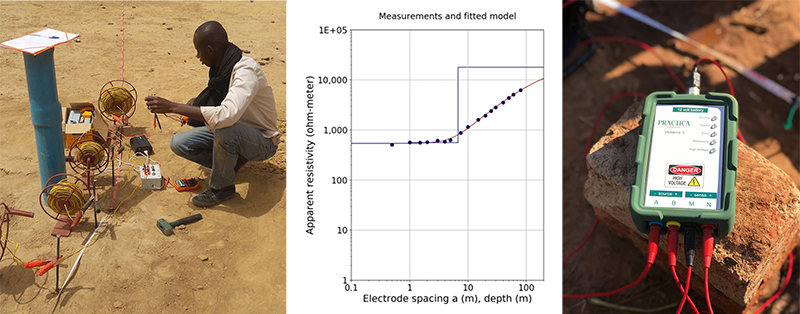
VES geophysics measurements with affordable equipment created by PRACTICA.
Some of our latest developments are in the field of affordable geophysical instruments and data management based on resistivity measurements. Low-cost siting offers a new tool for enterprises and practitioners to assess the geo-hydrology and increase the success rate for well drilling.
PRACTICA provides full resistivity siting kits, a low-cost resistivity device called Volterra 3, and provides training in the field data collection and interpretation of resistivity data. The resistivity kit is used together with the Drillers’ Toolbox smartphone application that PRACTICA has developed, which has a module for capturing and displaying resistivity data. Because the data is immediately visible in the field, quality issues can be identified straight away and corrected, leading to better quality data.
In Ivory Coast, this kit has been used by two teams who have conducted over 100 fields measurements, resulting in high-quality data that was subsequently interpreted by trained geophysicists. The kit is being used in Liberia, New Guinee, Sierra Leone, Mozambique, and other locations.
Data management
Data from siting, drilling, well construction and pumping tests is very valuable for future groundwater development projects. However, in low-income countries hydrogeological data is often either not available or scattered across different locations, kept at the offices of NGOs or embedded in consultants’ reports — frequently only in paper format. Regulatory bodies are often poorly financed, and practitioners such as drillers or supervisors have little capacity to manage and capture data effectively. When new water points are created, no simple tools exist to capture, store and share the data that is generated in a digital format – such as geophysics results, drill logs, and pumping tests. Therefore, data is often not collected, is of poor quality, or lost over time.
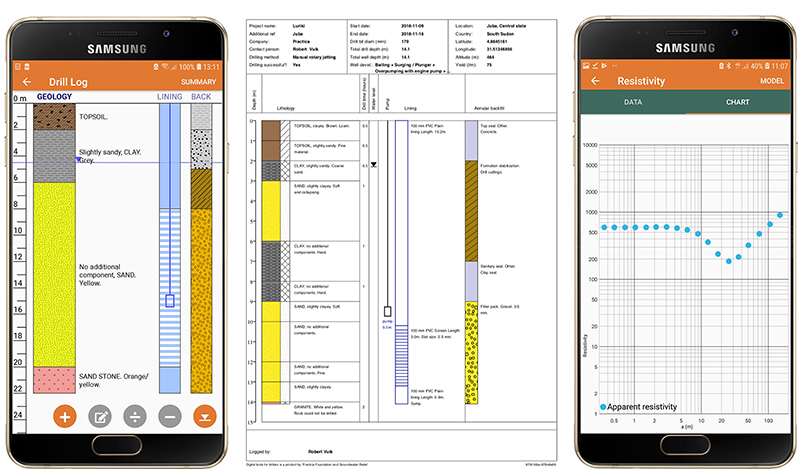
Screenshots of the dril log and geophysics modules of the Drillers’ Toolbox. PRACTICA creates smartphone apps in-house.
PRACTICA Foundation, together with supporting partners Groundwater Relief and MSF, has developed a set of tools to capture geophysics, drilling and pumping test data in a digital format. This Drillers’ Toolbox consists of a smartphone app (android only) and an online dashboard. Users receive high-quality PDF or Excel reports with the data and results. The toolbox complements existing databases and focusses on the field data collection process.
The Drillers’ Toolbox smartphone application has different modules that each specialise in capturing a particular type of data: resistivity geophysics data, drilling logs and well construction, and pumping test data. All data is georeferenced. Depending on future demand, we will consider adding additional modules to the app, such as water level monitoring and water quality measurements.
To use the tools effectively for improved data capture, data management and quality control, it is important that users receive adequate training. PRACTICA provides dedicate training packages on the different subjects, such as drilling supervision training, training on siting with resistivity measurements, and pumping test training. We train NGOs, drillers and supervisors.