FR
Sanitation
Urban fecal sludge management chains
In urban areas of low-income countries, improving sanitation faces big challenges in terms of technology, economics and partnerships. Given the complexity of managing excreta and waste water in densely populated neighborhoods, innovation is required at each step of the chain fecal sludge management chain.
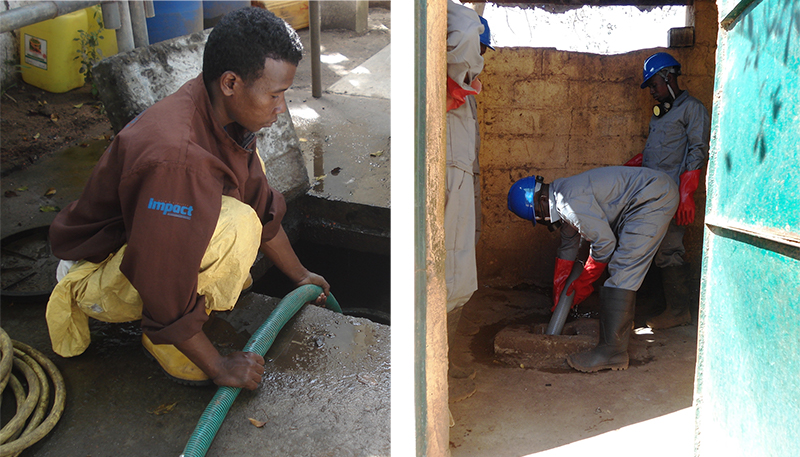
Pit latrine emptying services.
For excreta collection, there is a need for the development and promotion of affordable latrines, soak pits and toilets that are more user-friendly and easier to manage. The next step in the chain is the establishment of efficient and sustainable waste management services, which remove and treat fecal sludge. Finally, the waste can be turned into a resource. Linking sanitation service providers to other sectors allows reuse of waste, for example for agricultural or power generation purposes.
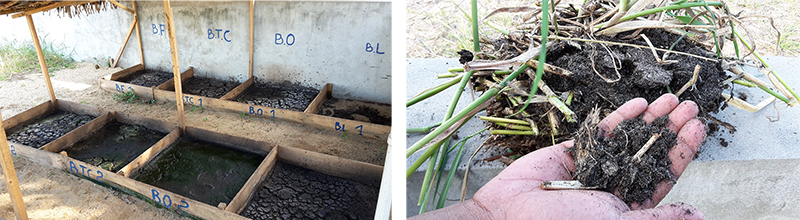
Experiments in treatment for reuse in Madagascar.
PRACTICA develops and disseminates sanitation products and solutions that support a technically and financially viable sanitation chain. Currently, we are involved in several large-scale projects in a number of African cities. In Lusaka, Zambia, we have provided technical assistance for the design of new Fecal Sludge Management (FSM) businesses, to be deployed by the Lusaka Water and Sewerage Company over the entire city. As a part of this work, mechanical desludging units, based on slurry tankers and HP-cleaners, have been especially designed to cover the needs of low-income neighbourhoods.
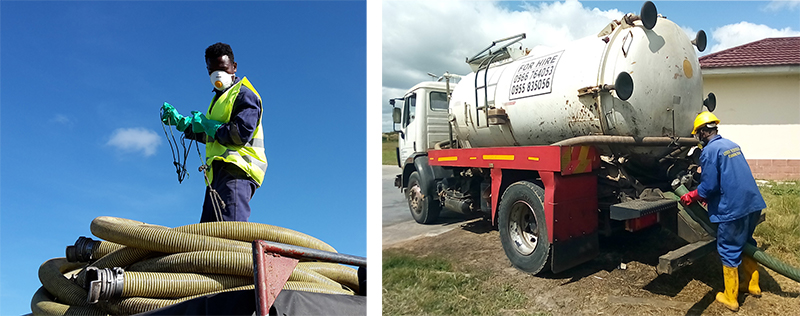
Pit emptying service in Lusaka, Zambia, trained by PRACTICA.
In Parakou, Benin, PRACTICA assists the municipality in the implementation of its sanitation masterplan 2015-2035. As part of this work, innovative public toilets were designed and build, as well as an entrenchment site to pilot low-cost fecal sludge management with reuse of nutrients for agroforestry.
Finally, in Fainaransoa, Madagascar, PRACTICA together with partners implements the 3F project, a three-year project supporting the Municipality of Fianarantsoa in setting up a full fecal sludge management chain. 3F includes the construction of a new generation of public toilets, as well as the setting up of sustainable FSM services for 40,000 inhabitants of a mountain town. Both slow pyrolysis and co-composting reuse options are being piloted within this project.
A growing number of municipalities contact Practica to benefit from the package of solutions we offer at each step of the development of the fecal sludge management chain. Having supported the development of several emptying businesses in Madagascar, Mali, and Benin, our knowledge of these businesses enables us to design and set up viable and sustainable FSM services and public-private partnerships.