 FR
Rainmaker irrigation system
Solar-powered irrigation offers clear benefits to farmers, including the absence of fuel dependency and a longer pump life span. However, conventional irrigation techniques and investment mechanisms do not provide an optimal context for the scale-up of solar irrigation. For example, in contrast to motor pumps, solar pumps run many hours a day, and need application methods that operate under low pressure.
Solar pumps can help farmers to reduce production costs since no fuel is required. However, solar pumps have a much lower flow and pressure compared to motor pumps. Conventional irrigation techniques, such as furrow irrigation or sprinklers, are designed to be used by motorised pumps. In combination with solar pumps however, these techniques lead to a very low water efficiency, poor water distribution and/or a high need of labour. When used in this way, solar irrigation will be more expensive than motorised irrigation systems. As a response, Practica has developed the rainmaker system, that runs on low water pressure and does not require the presence of a farmer during irrigation. In this way it saves time and uses the water more efficiently, so that farmers can grow more with the same amount of water.
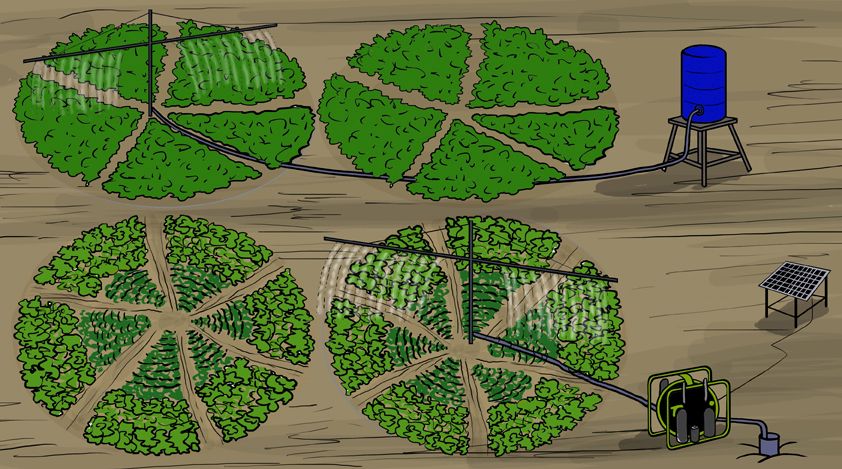
Artist impression of the rainmaker in combination with a solar pump.
The Rainmaker is a downsized and affordable pivot irrigation system consisting of two long arms that distribute the water evenly. It covers 120 m2, after which it can be moved manually to the next section of the plot. The rainmaker can irrigate an area of 1000 to 2000 m2 a day, depending on the pump that is used and the frequency of moving the pivot.
Compared with motor pumps, a solar pump combined with a Rainmaker provides a more gradual water delivery to the soil. This prevents soil erosion and nutrient leaching – which contributes to a sustainable higher production in the long run.
Interested?
If you are interested in the Rainmaker, please contact us to find out more.
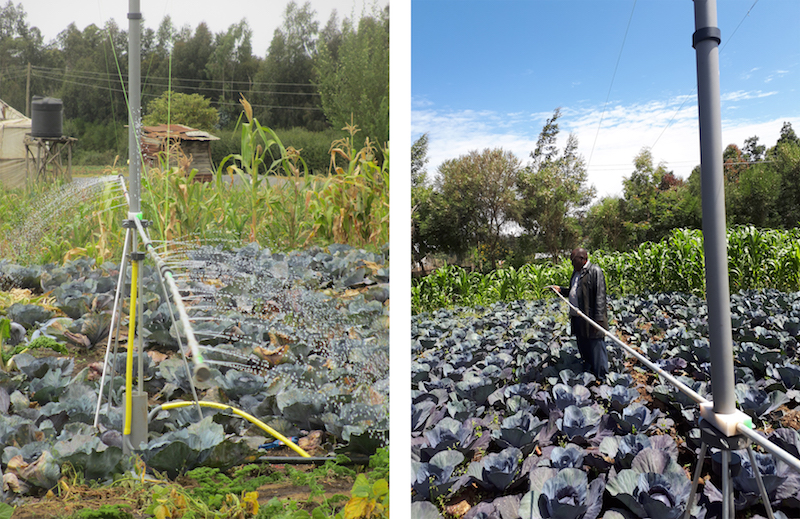
Field trials in Kenya.