 FR
Rural water supply
Many rural communities in low-income countries still lack access to clean water. Even those with safe water access, face the risk of reverting to unsafe water sources as existing water infrastructure continues to break down. About one third of the water systems in sub-Saharan Africa are non-functional. In addition, many water systems (15-30%) break down within one year after construction. Poor management practices and insufficient finance to cover recurrent costs, and poor planning, siting and construction form major stumbling blocks on the path towards sustainable rural water provision.
The disappointing results of rural water projects heavily impact on the health of rural communities and is hindering the progress towards the Sustainable Development Goal 6 that aims to achieve universal, equitable and affordable drinking water for all by 2030.
PRACTICA aims to close the water service gap in rural low-income areas by supporting governments and WASH actors to establish low-cost, affordable and financially viable rural water services. PRACTICA focuses on three key intervention areas.
Support planning and design
We support WASH actors in the crucial planning and design phase. This first stage is critical for securing the quality, affordability and financial viability of rural water services. We conduct assessments, develop and optimize rural water system designs and provide insight in the expected costs and revenues through detailed financial modelling.
Strengthen Water Service Providers & private sector
Through technical and management trainings and innovative financial management tools, we strengthen the capacity of local water service providers and other relevant WASH actors to sustainably manage rural piped water services. Where necessary, we strengthen and equip the private sector with the technical skills to construct, supply and repair rural water services.
Develop smart and robust technological solutions
Where we encounter gaps in available technologies, we develop smart and robust technological solutions that improve rural water service provision. Our latest development, the TokenTap, consist of a token based, mechanical prepayment water dispenser with monitoring. It is a robust and easy to repair alternative compared to existing prepayment solutions on the market. This device allows rural water service providers to efficiently generate water revenues to cover the cost of operation while also being able to track the water sales remotely.
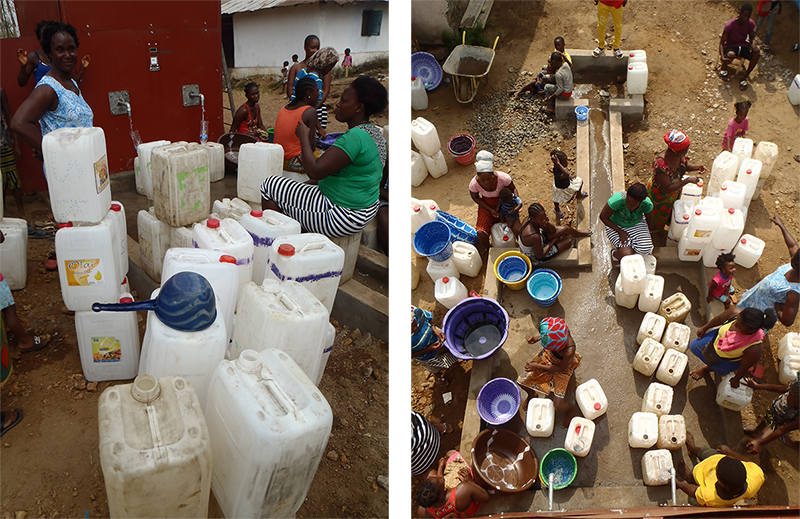
A solar powered modular water system developed by PRACTICA, being trialed in Liberia.
Modular Solar Water Systems
PRACTICA is committed to support the upgrade of handpumps into affordable decentralised piped water systems. Piped water systems reach more people than a single handpump, increase the service level and require less frequent maintenance than handpumps.
PRACTICA has developed remotely monitored modular solar water systems that can replace a handpump. It consists of a solar pump combined with a water tower that dispenses water by means of a prepayment system. There are multiple sizes available, starting with the smallest version able to supply water to about 250 people. With standardized designs for the locally produced towers the concept is ideal for upscaling. The system can be expanded to support piped connections.
When more water is needed, or more people need to be served, additional public modules and household connections can be established— either side by side using the same borehole, or in different convenient locations. This means water systems can be established at a minimal costs: additional modules can be placed when the need arises.
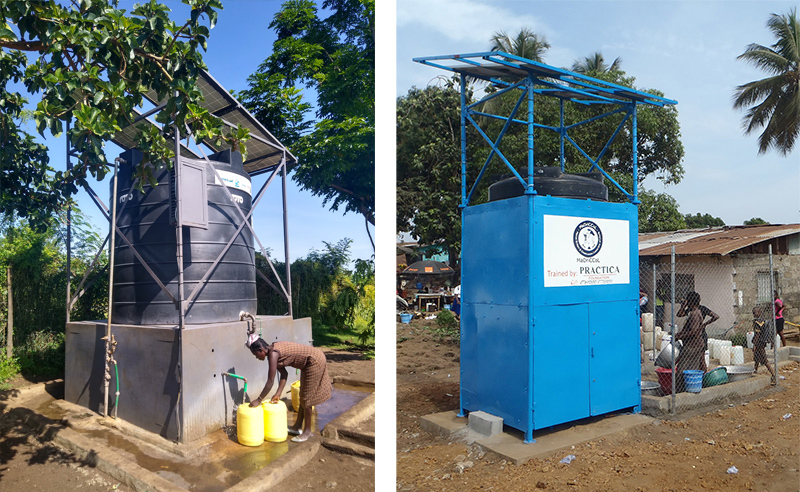
Modular solar water systems in Kenya and Liberia.
WaterTime
The sustainable operation and maintenance of rural water supply systems needs the successful involvement of many different actors. PRACTICA works with a comprehensive service delivery approach that involves both public and private partners called ‘WaterTime’. WaterTime takes the business case of water service provision as its starting point and supports water service providers to recover their costs, expand the service and deliver reliable water services to rural households.
WaterTime combines innovative pre-payment and monitoring technologies with external support services, and provides management training and tools for enterprises, entrepreneurs, associations and government actors. Its four components are:
- affordable rural water service provision through a stepwise building approach from handpumps to safely managed water services;
- professional water service provision through skilled and trained water service providers;
- ongoing post-construction support to water service providers;
- access to credit to expand water services.
Through its stepwise approach to a higher service level, it provides the rural water sector with a route to transition from basic handpump technology towards piped water services in rural and peri-urban areas.
Within a WaterTime program, PRACTICA provides technical support and technical, financial and management trainings.