Results of applied research in the production and performance of ceramic pot filters
Presentation
October 2014
Herman Jansen
Abstract:
Results of applied research in the production and performance of ceramic pot filters.
Water & Health conference. Side session on ceramic pot filters, 17-10-2014.
Dutch research group on ceramic pot filters:
Herman Jansen ( Practica Foundation, www.practica.org )
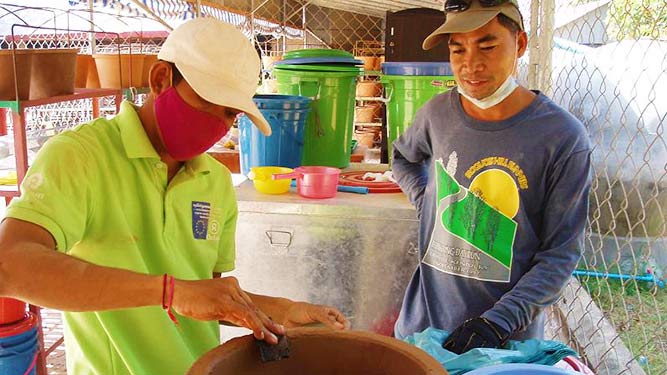
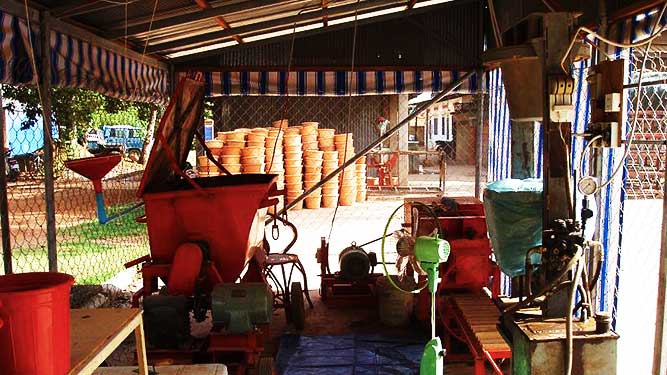
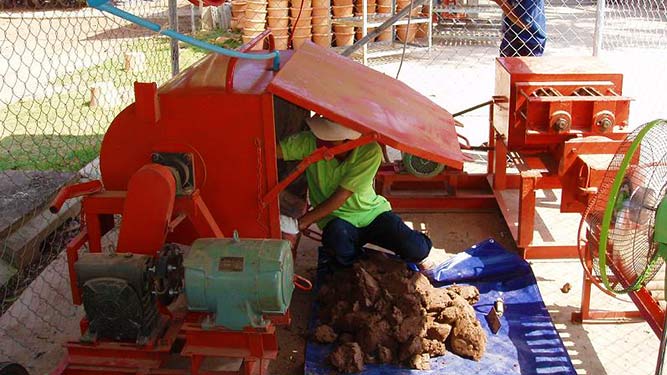
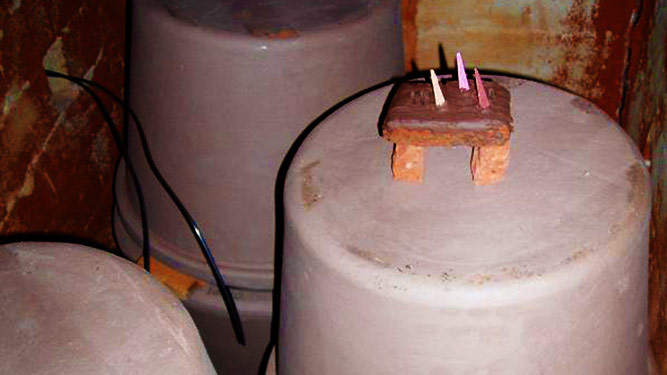
A pilot plant in Cambodia was build in order to produce ceramic pot filters in batches of 6 pots for further research. Between the batches a number of parameters were changed. The aim was to get more knowledge about the critical parameters, so that a more constant product could be obtained.
The other objective was to improve the filter, especially to get a higher flow rate without compromising the LRV and maintaining sufficient material strength. The following parameters were investigated: Silver application, clay to rice husk ratio, maximum firing temperature, and the particle size distribution of rice husk.
At the Delft University of Technology1 the role of silver was investigated on the removal of bacteria and viruses.
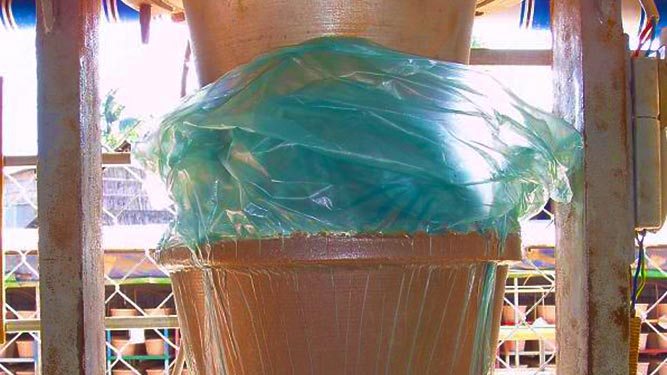
22 Ceramic pot filters from Cambodia with 4 different rice husk contents were investigated during a 16 weeks experiment under falling head operation.
A distinction was made between inactivation by silver during the filtration step and the subsequent storage step. Three different silver applications ( both sides , only outside and none) were compared.
Samples were taken within 5 minutes after filtration.
There was no significant difference in the LRV of E.coli between the three applications.
The conclusion is that during the filtration step the inactivation by silver is not the dominant factor, but that physical removal mechanisms are responsible for the LRV during the filtration step.
The dominant parameter for the inactivation of E.coli by silver is the storage time in the receptacle.
The virus removal was rather low (LRV 0,6 ); lower than for E.coli .
There was no difference between filters with and without silver. Thus there is no confirmation that absence of silver does enhance the virus removal as supposed in earlier research.
At RDI in Cambodia2 ,3 the other parameters were investigated.
Measured were the initial flow rate (under constant head) , the LRV of E.coli and the MoR ( Modulus of Rupture) as measure of the material strength.
With respect to the flow rate one can conclude from the measurements, that a significant increase in flow rate can be obtained from 3 to 10-15L/h without loss of LRV by increasing the amount of rice husk in the clay mixture ( increasing the porosity).
The flow rate can also be increased by using larger rice husk particles. But in that case the LRV will get lower.
The increase of rice husk to clay ratio causes a reduction of the MoR. On the other hand the material strength is increased by firing at a higher maximum temperature.
An increase in the maximum firing temperature from 660°C to 950°C causes a slight but not significant reduction of the LRV.
Concluding:
The flow rate can be increased significantly without compromising the LRV by increasing the porosity
The pore size, depending on the particle size distribution of the rice husk, turned out to be the main critical parameter for the bacteria removal effectiveness.
Therefore critical selection and control of the particle size of the rice husk is a necessity .
Crucial for chemical disinfection by silver is the receptacle for safe storage, which allows for the essential contact time with silver.
1) H.van der Laan et al. Bacteria removal effectiveness of ceramic pot filters with different silver applications in a long term experiment.
Water research 51 (2014 ) 47-54. Contact: harmen.van der.laan@oasen.nl
2) A.I.A.Soppe et al. Critical parameters in the production of ceramic pot filters for household water treatment in developing countries. To be published. Contact: gsoppe@planet.nl
3)I.Gensburger,2013,The ceramic water filter, Investigation critical parameters in the production of ceramic pot filters (draft).
 FR